What’s Missing From Queer Love Stories

A quiet reflection on queer love, media, and what’s still missing
We’re in a moment where queer love stories are finally being allowed to be soft or at least hold multidimensional, complex characters.
Some are romantic and tender, others a bit idealized, sometimes messy, but unmistakably centered on love. Recent films and shows like Red, White & Royal Blue, Heated River, Bros, 10 Dance, and even the now-cancelled Boots all share something in common: queerness isn’t only about survival. It can simply be lived. Each of these stories offers a different perspective on gay male identity, and for once, we’re moving away from a cookie-cutter formula toward variety.
Embarrassingly enough, I’m a secret rom-com dork. What can I say, call me cliche but, I looovve, love.
Watching this wave of stories, I found myself sitting with a quiet question, almost hesitantly:
Where is the Black boy love story?
I don’t mean the tragic one. Or the cautionary tale where love only exists alongside loss.
Just a story about Black boys, Black men, falling in love.
Whenever this question comes up, it tends to create discomfort. Mention race, and you can almost feel the internal eye twitch — the pause before someone pivots to “But what about…?” And yes, Black queer stories have existed. But barely. Moonlight came out in 2016. It’s been nearly a decade since.
Inclusion isn’t the same as centering.
And visibility isn’t the same as being allowed joy.
On the Black gay side of social media, there’s been a recent resurgence of Noah’s Arc, a show that first aired in 2005. Nearly twenty years later, it still stands as the only series to portray Black gay men as multidimensional, romantic, flawed, funny, and fully human, outside of constant crisis. The fact that it’s still referenced today speaks less to nostalgia and more to absence.
After Noah’s Arc, the next widely recognized Black gay love story to reach the mainstream was Moonlight. A beautiful and important film. And also one deeply rooted in silence, pain, and survival. Even when love appears, it does so briefly, carefully, as if joy itself might be too fragile to sustain.
This isn’t a critique of these works i'm only calling out a pattern.
When Black queer stories are told, they’re often framed through trauma: HIV/AIDS, addiction, violence, rejection. The message isn’t always explicit, but the lingering idea is that our love must be justified through suffering in order to be seen as meaningful....and that’s what makes the absence feel so loud.
Between the ages of 15 and 20, I had a couple of partners- both Black boys. And yes, one of the love story existed in the shadow of not being able to be out to our families. But beyond that, both were fun, light, uncomplicated and normal. We didn’t have representation or the language for what we were missing., we just lived it.
That memory stays with me, because it reminds me that Black queer love doesn’t always begin or exist solely in trauma, it’s often edited into it.
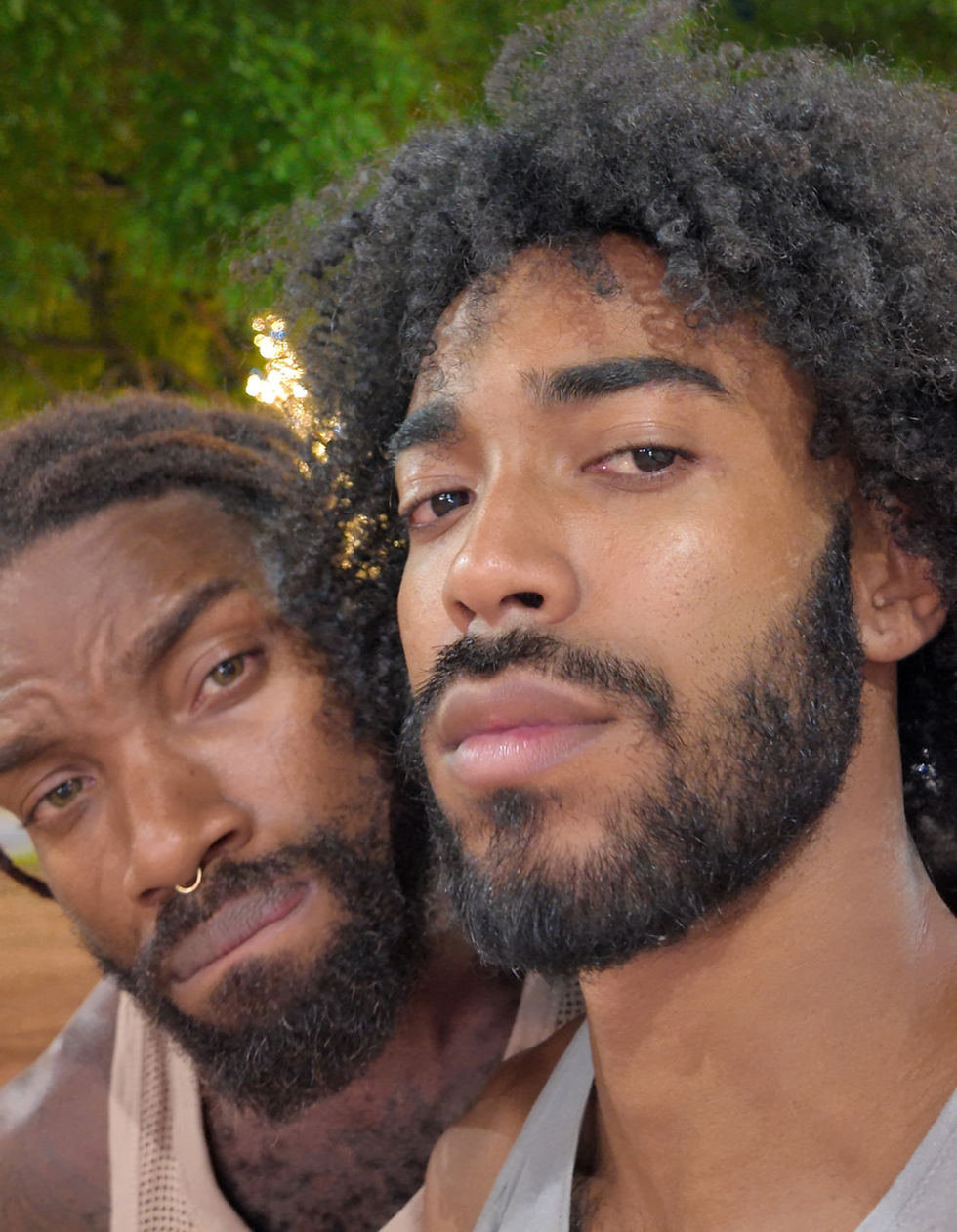
It’s the day after Christmas, and I just spent the holiday with my boyfriend’s family, a room full of people who were warm, loving, inviting, and kind. There was no tension, no spectacle, no trauma attached to me and my partner, or to his sister and her girlfriend. Everything was normal, we were just another couple at the party. The only differences noted was the fact that I was a foreigner who couldn't win an argument with a two year old in Portuguese. Hahaha
Sitting here, I'm thinking how ordinary and meaningful that felt and how rarely stories like this are centered when Black queer love is depicted. Even in my own life, and among friends in Black partner relationships, our love isn’t defined by suffering. It’s defined by care, laughter, and shared moments like this one.
We talk frequently within the LGBTQ+ community about representation, and rightly so. But representation isn’t just about being seen, right? It’s about range.
Who gets to be romantic without punishment, ordinary without erasure, and complicated without being labeled “broken.” My hot take is this: media doesn’t really reflect culture, it shapes it. The stories that are funded, marketed, and celebrated become blueprints for how people understand themselves and what they believe is possible.
We’ve seen this again and again in the way fictional characters become cultural reference points, even deeply flawed ones. Look at how many women and gay men self identified themselves as a Carrie Bradshaw or a Samantha Jones? See? You get it. (Side note: can we all collectively agree that Carrie was the problem?)
But to wrap this up, I keep returning to this question (not angrily), but honestly:
Who will tell the Black boy love story that isn’t rooted in trauma?
And when?
We want and need a story that doesn’t require tragedy to feel real. One where our love is allowed to exist fully, softly, and unapologetically.
Because I refuse to believe our story is rare, how could I when i'm seeing these stories in the friends I have in the real world.


I have been following your social media for a while now and I have always loved and felt your confidence and authenticity through a screen.
I do think about this myself, and one of my closest friends, Anthony, who is Black and from the southeast side of the East River in NYC, has been there for me as a shoulder to cry on (so many times now) while I go through the hardest breakup of my life.
Anyway, too much context.
I have tried having these kinds of conversations with him, and he never seems to really want to engage too much with them on a deeper level. I will say he is living his life happy and with authenticity……